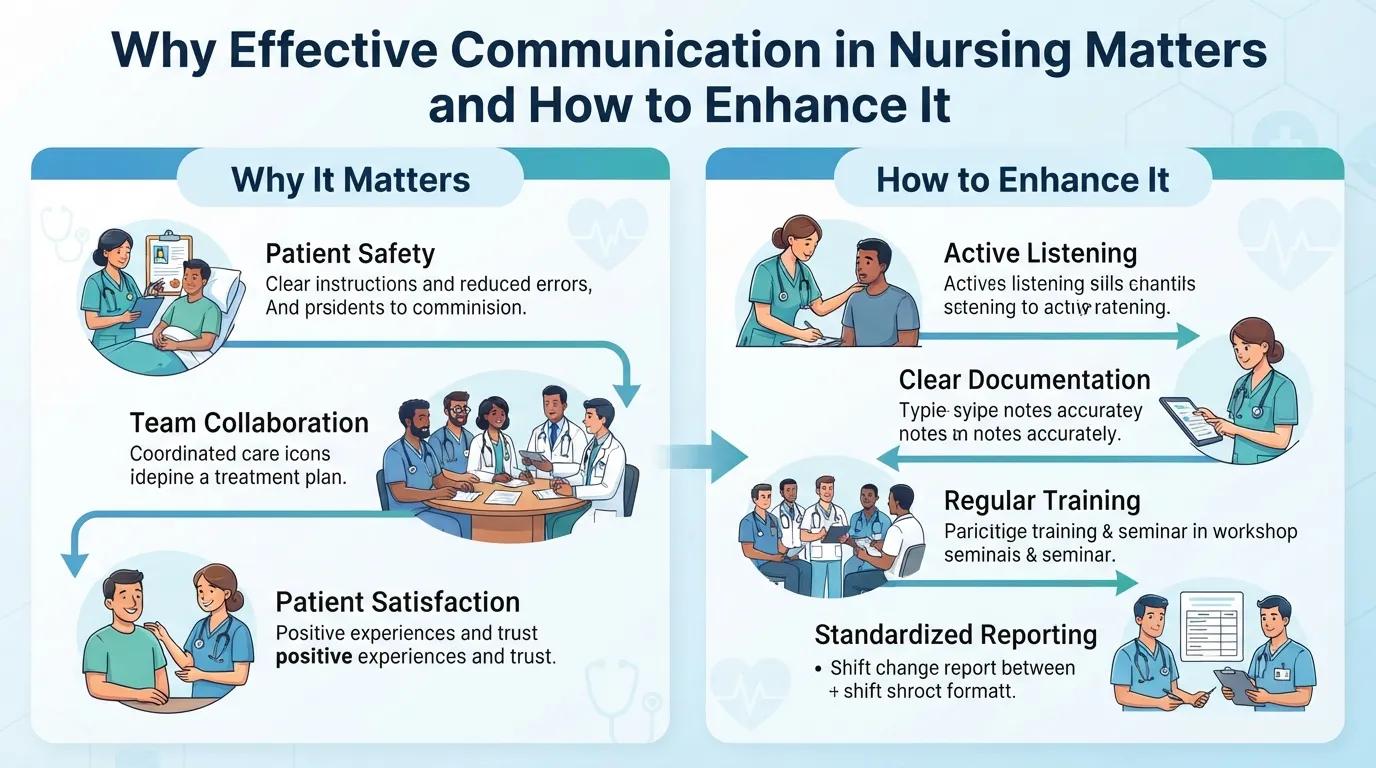

Nursing is one of the most essential parts of the healthcare system. The patient`s well-being relies on medical treatment and the care provided to them. So, whether you are a nursing student or a professional. Thus, the key element that connects technical skills with patient care is effective communication.
Well, having good communication skills is also important for collaborating with teams. such as your fellow nurses and colleagues. Hence, you should give your time to listen to them. And understand the queries and concerns of patients. Thus, it results in better patient outcomes.
On the other hand, poor communication in healthcare leads to misunderstandings. Furthermore, it can also lead to breakdowns in workflow that result in a medical mistake or error.
A report by the Joint Commission found that A lack of communication in healthcare during patient transfers results in 80% of serious medical errors.
Hence, effective communication impacts the quality of decision-making. As well as the level of patient motivation to follow the treatment.
Top 7 Effective Communication Skills and How to Enhance Them
Whether you are a nursing student or a professional, effective communication matters. So, to improve it, we will explore 7 communication skills that are important in nursing. If you want to learn more about them, you can seek nursing case study help from professionals. They can tell you in detail about these skills.
Furthermore, we will also explore how one can enhance these skills. So, what are you waiting for? Let us start exploring them.
1. Verbal Communication
One of the most essential keys to effective communication is verbal communication. It aims to always speak with clarity, honesty, and accuracy. However, for nurses, it is important to know your patients and speak effectively. According to their age, health literacy, and culture. One of the common mistakes that you should not make is if you are feeling stressed or frustrated. Then be aware of your tone of voice and do not ever let these emotions come out while interacting with the patient.
Yet, you can enhance it by:
Encouraging the patients to communicate. You can ask them questions like, “Can you tell me in detail about that?”
Use the patient`s first name or name of choice, instead of calling them “sweetie” or “honey”.
While speaking, use clear and complete sentences.
2. Nonverbal Communication
Nonverbal communication includes facial expressions, eye contact, gestures, body language, and voice tone. You can effectively communicate by simply smiling. It can go a long way toward removing the communication gap with patients.
You can enhance it by:
Showing that you are interested in what the patient is saying. By simply maintaining eye contact and shaking your head.
By smiling, but remember, do not stare.
Lean forward or sit down to show you are engaged with the patient.
Use effective body language that helps in conveying openness.
3. Active Listening
It refers to listening to understand the otherperson'ss experience. However, one of the most effective and highest forms of listening requires one’s complete attention and engagement.
This skill is not only important for clinical nurses, but it is also important for nurse executives and other healthcare providers. Hence, it acts as a tool for building trust and commitment among staff.
Yet, active listening includes verbal and nonverbal communication skills.
You can enhance this skill by practising:
Shaking your head, but never interrupting them.
Maintaining eye contact and leaning forward, so you can let the person know you are listening.
Using concise verbal communication, like “I understand” and “Go on”.
4. Written Communication Skills
Another effective communication skill that you should improve is written communication. It is also an important skill for effective one-to-one communication among nurses. However, as a nurse, you have to create and update the patient's medical records. Hence, it is essential for you to correctly maintain the records. So that the patient can receive the best care.
Furthermore, you have to make sure that you protect the patient`s privacy and confidentiality.
The following are some tips that can help you enhance this skill:
Make notes of patient care as soon as possible. So that you don't forget anything.
While writing, use clear and concise wording.
Make sure that you note down the accurate time and date.
5. Presentation Skills
Presentation skills are one of the most applicable skills. When you are transferring a patient’s data to another nurse or other healthcare providers.
Yet, this skill will also help you in showcasing your knowledge in different workplaces. While presenting at conferences. Furthermore, it can help you show your expertise in job interviews or when giving case reports to other physicians. You can use these tips to improve it:
Planning out your practice and presentation.
Paying attention to both your verbal and nonverbal communication.
Adding graphics and visuals to a presentation for better explanation.
Knowing about your audience, like what they want from you and your presentation.
Extra Tip: If you want to have a grasp on this skill. Thus, consider seeking help with nursing assignments. They will help improve your presentation skills.
6. Patient Education
Well, as you may know, nurses are in charge of most of the communication between healthcare providers and patients. It includes informing the patient and their family members about the health conditions, treatment plans, and medical protocols. This skill is important for those who work with patients and families to provide counselling on health and education.
It is one of the most effective communication strategies where providers ask patients to repeat the information. Patient Education helpsimproveg patient understanding and gives effective care instructions. On the other hand, poor communication can become a reason for their anxiety or make them defensive.
You can say:
We have discussed a lot of information. So to make sure that you don’t forget it, can you please repeat it back.
Can you repeat the instructions for taking medicines back to me?
Let’s get an overview of what we discussed. Can you explain it in your own words?
7. Making Personal Connections
Well, you need to get to know the person behind the patient. It helps patients feel comfortable and safe. Thus, making meaningful connections with the patients can help you gain their trust. Tips for improving this skill:
Give your time and spend a couple of extra minutes with each of them. Furthermore, try to get to know them in person.
Try to find out a fun fact about each patient
Share your own stories and show interest in their lives.
Final Thoughts
In conclusion, learning these effective communication skills will help you make a connection with patients. Hence, it will result in good patient care. So, whether you are a nursing student or a professional. You should try to enhance your effective communication. So that you can take good care of the patient. Good Luck!